Bobbi and I scheduled one last cross-border dive trip for this weekend. It was time for Bobbi's visa renewal and we held off submitting her passport so we could use her still-valid visa for one last crossing. But she wanted to visit her mother in February and she would need to apply for a renewal soon afterwards. Those visa renewals can take weeks. With both Bobbi and I doing them annually, we are each without passport for a month each year; e.g. two months a year that one of us doesn't have access to one of our passports.
So we booked our usual room, called by staff the "Vance Special" at our favorite chill-out place, Nomad Ocean Adventure. After a hectic work week, arrival at the border is still not completely without hassle, but once across life goes on hold. We check into our pleasant room. We go for a jog to the Golden Tulip and back. By the time we've showered it's time for the dinner buffet. We linger there and talk to people we see there time and again till sleep calls everyone to their rooms, and we sleep late in the morning. We can sleep late because the dives depart at 9:30, plenty of time for coffee and meager continental breakfast which holds us over till after our first dive an hour away by boat, when a filling continental lunch is served. We dive again and return mid-afternoon to port, and go for a jog if we feel like it, or just soak in the pool, maybe both. The cycle of dinner, small talk, early to bed, late to rise, and diving repeats next day, Saturday. But once back in port, we scurry to get back across the border, checked out of Nomad, and home 3 hours later.
This weekend we went in search of decent visibility, starting with Ras Morovi north side, and Lima north after lunch. The following day we did Ras Morovi and the hidden reef the first dive, Wonder Wall to round out the day.
I'm bLogging this diving long after the fact and don't recall much remarkable. But check the videos and see.
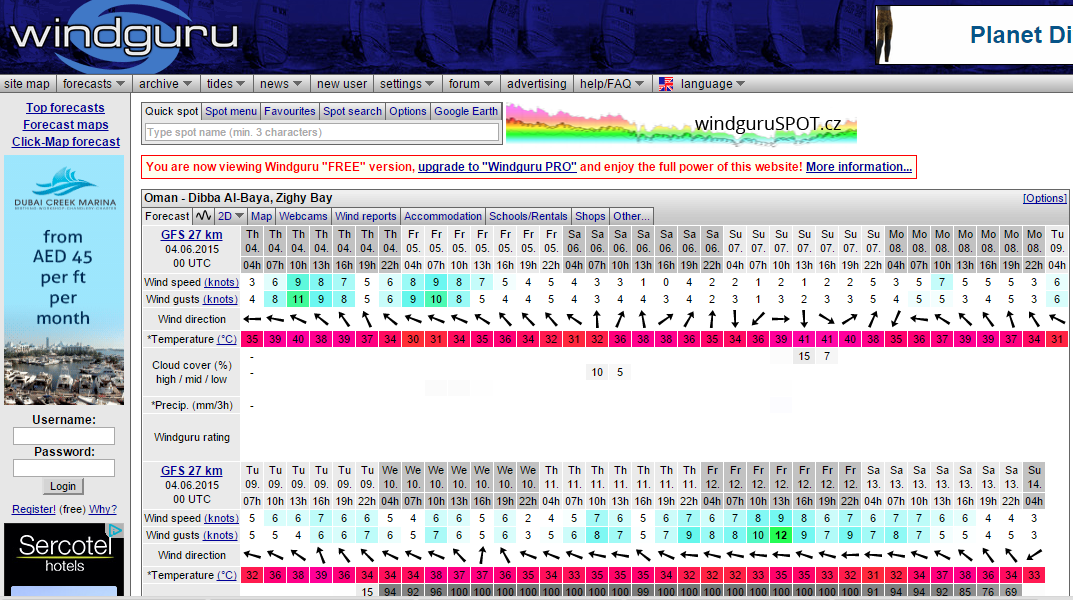
My logged dives #1369-1370 We got a call from AB at Nomad Ocean Adventure as we were leaving the house on Thursday to head down early and meet some dive students. He wanted to inform us of the developing weather situation. The north of Musandam was experiencing rough seas and boats were not putting out from Dibba harbor that day. Local weather sources were reporting as much but the usually trusty Windguru raised no alarms, as in this view from earlier that morning:
We were looking forward to the weekend, meeting 4 students there that night, and if worse came to worse we could do pool modules all day Friday. Nomad said the storm was due to diminish by mid-day and perhaps we could take a boat out then. I sent email to my divers and Bobbi and I hit the road for Dibba. We took the way from Shuweib to Madan to Dhaid, and except for wind blowing sand across the highway, blocking one lane for a long stretch and reducing visibility, we missed the traffic on the 311 Sharjah and reached Dibba through the scenic mountain pass from Masafi in 2:45 minutes from Al Ain, a comfortable drive.
Our students had rental car insurance hassles and didn't arrive till 10 pm. By then most divers had cancelled including all the fun divers in our party, except Daniel Sobrado who was coming with his Spanish friends Alfredo and Rodrigo, to whom he'd referred me as a dive instructor, along with Roula from Lebanon and Jihaine from Tunisia. These all worked together at the same bank and would be my students for the weekend. It didn't look like diving would happen next morning (Brad was going down at 5 a.m. to check with the coast guard, and when he got there he called the group from Dubai and told them to forget it).
So our group met at 7:30 for breakfast and briefing. We would try to get three modules in by noon and see if we could go out in a boat then. That turned out to be impossible since the weather was still rough in the north by then, so we made a long day of it in the pool. We were finally in the water around 9:00. There was no rush, and with 4 divers at different ability levels, delays can be expected. With the extra time, we made sure everyone had plenty of space to accomplish the skills successfully. We finished module 2 in time for lunch, and what happens after lunch? Siesta :-) We were in no hurry. We knocked off module three that afternoon. The group was willing to continue but it was getting dark, and frankly, we were all tired. We decided to relax over dinner.
We met again at 7:30 next morning to see if we could do module 4 but only managed the underwater part, no time for the surface work before we had to get ready and go diving at 9:30. In the event we got off to an only slightly late start and cruised in fairly smooth seas all the way to Ras Morovi. There we found plankton and green, murky water, so AB recommended we move down to Lulu Island for our first open water dive of the course. This is sometimes a challenge for many students. The water was colder than expected, and ear and buoyancy problems kept us in the shallows for the first ten minutes, while poor visibility split our group temporarily (but AB is an instructor, they were with him, and he returned them safe and sound). We eventually got our dive in, all of us underdressed, me in lycra and rash vest, and the two guys in shorties, so it was cold, visibility poor, but there were moray eels, and fusiliers and jacks as we rounded the island south to north, and the group stayed together and ascended well.
I didn't take any videos on that dive and I changed into 5 mm for the next one, which we did after a surface interval that included a 30-min siesta on the boat in the sheltered waters off Lima headland north. Everyone found a place to stretch out it seemed until AB barged forward and brought us out of our dreams. He offered us our choice of spots, so I selected Lima Rock north, so AB would have a chance to see the big fish with the initials WS, and Daniel could dive with him and maybe see it too. I checked the current on snorkel before agreeing to the spot, but the depth here was not ideal for our group of beginners, as sand there begins at 11 meters, and we would have to go there to do our skills. All divers had made it that deep on the first dive, but ear problems forced one to stay shallower than that on the second one, so in the end I took the three to the sand who could make it there and will plan a shallower dive for the other next time.
We didn't see the big fish with the initials WS but we found better visibility and more life on Lima Rock. I found a crawfish in a cave as we were descending, and Bobbi found a couple of cuttlefish that didn't mind us coming close and filming. There were lion fish and moray eels, and while doing skills with one of the students, I saw a disc move into view just at the edge of my vis and settle on the sand, looked like a ray of some kind. I finned to check it out and found a torpedo ray (these are electric and will jolt you if touched). He moved about and rippled around for me and this rounded out our videos.
It's only the second time I've not been able to complete a course at Nomad due to weather in many years of working with them, but I'm looking forward to having this group back in a couple of weeks, and signing them off as open water divers.
I've been doing a lot of diving lately but I've been working on an article for TESL-EJ which I just finished and this has put me behind in my dive blogging. Meanwhile I've got videos still backlogged from the previous week's dive trip in May. Oon Friday / Saturday May 15 / 16 I conducted an advanced course on Dibba Rock at Blue Planet Diving. I'm hoping to get these posts and videos up shortly, but for the record, these would be:
My logged dives #1365-1368 But this past weekend the diving was quite special, and with that article out of the way, I'm posting May 15-16, 2015, my logged dives #1364-1367 This weekend I had long planned to conduct an open water course but one of the students had an ear problem that the doctor would not sign him off on, so both students postponed their course to June. I went ahead to Dibba and crossed the border to the humble yet dynamic compound of Nomad Ocean Adventure. Happily and coincidentally, I chanced to meet some good friends there from Al Ain, divemaster David Muirhead, and experienced instructors Bruce Ora and Gerry McGuire, and I was invited onto their boat. We departed next day for Lima Rock, which we dived on both Friday and Saturday. There had been whale sharks spotted in the vicinity the past few weeks and when the whale sharks are around, there's always the chance we will see one. The visibility was as good as I've seen it for a long time. Check out this video:
This video is a compilation of a stunning dive conducted on Friday, when we swam with a whale shark, and one on Saturday where we saw an eagle ray but no whale sharks (though there was one seen that day nearer shore on the headland opposite Lima Rock, off Ras Hamra). Our first dive on Friday May 14 was on Ras Sanut, what we also call Wonderwall. On this day the visibility was remarkably good. The video starts with Gerry McGuire easing through the water with no wetsuit, and me in my 5 mm !!!, followed by his buddy Bruce Ora and then by my buddy, David Muirhead, who joined me in a selfie at the start of the dive. From there the diving was full of marine life, as can be seen from the video:
Below is the video from our dive on Octopus Rock May 15. Visibility was excellent and current benign. David Muirhead and I followed Bruce Ora and Gerry McGuire to the east of the rock down to where the seahorses were (or as we observed, the seahorse was). David and I worked our way back up to where Abdullah was taking photos of flatworms and nudibranchs (he'd found several in a 10 meter square area). We found lots of moray eels, and batfish being cleaned by their blue wrasse friends. The dominant fish here are the blue "red-tooth" triggers, but there are jacks schooling in shallow water near the top of the rock, and I ended my dive amidst a large school of beguiling batfish. See for yourself:
My logged dives #1353-1356 Here are some videos from a pleasant dive weekend back on home turf, or waters, or whatever that stuff was, wth Nomad Ocean Adventure, the weekend of April 17-18, 2118. We went as a group comprising Nicki Blower, Chris Gawronski, Kelly Harris, Bobbi and I, and one of my open water students, Bonnie Swesey. We were possibly diving with Bonnie for the last time for a while, since she is heading off to a new life in Honduras, where the diving is superb (so we hope to visit her there one day). It's always good to be back home with Nomad, good food and sound sleeping, especially when our responsibilities are nothng more than to conduct safe dives. Our sites and dive times were negotiable, no one telling us where to go or when to come up, and the last day I suggested to our Nomad Pro Cedrick that we do our last dive on the outside ocean side of Morovi Island, where currents can be interesting, but there's lots of blue coral and blue triggers on a 20 meter wall with no telling what's in the sand (and he agreed, so we got to choose a rarely dived site, and Cedrick seemed quite happy with the choice - he's working at Nomad temporarily, commissioned to paint a mural of a whale shark on one of the walls there). We didn't see much on the wall ourselves, but we certainly enjoyed these dive sites: April 17 -
Dive 1 - North side of Lima Rock, decent vis and lots of interesting creatures there
Dive 2 - Wonderwall (Ras Sanut) poor vis, chilly, and a couple of giant rays (worth seeing)
In the video posted here, all shots are taken on Lima Rock, except the video of the huge ray at Ras Sanut, in poor visibility
April 18 - Nicki was sick last day and we were joined on our dives by a lady from Finland, a petite (but tatooed) guard on the Ukraine / Russian border, down for a first visit to UAE, and discovering the diving is not bad here :-)
Dive 1 - Octopus Rock, always a great dive, only a slight current, great vis, great fish life
Dive 2 - Outer (east side) Morovi Island, good vis, tricky currents especially where we ended at the south corner, but a pretty dive. It's especially nice when you can move back north in the channel itself. We saw some baraccuda there today (they love current), and at other times rays, including eagle rays. But today the current prevented our northward progress and we had to end the dive on the corner.
My logged dives #1300-1303
No one, not even me, seemed to notice that I made my 1300th logged dive with Bonnie Swesey, the kind lady who put Bobbi and I up, or put up with Bobbi and I, in her flat for Bobbi's last year teaching at ACS in Abu Dhabi while we both resided in Al Ain and Bobbi commuted occasionally, but not every day, thanks to Bonnie's hospitality. In return I offered to help Bonnie get back into diving with an intensive refresher course. We didn't do an official course, I just took her diving, and by the end of it we had restored her to compos mentus with her basic diving skills.
Also in our group were my lovely wife Bobbi, our best dive buddy Nicki, and a newcomer to our team, Kelly. We dove for two weekend days, Friday and Saturday Aug 29-30 from Nomad Ocean Adventure in Dibba Oman, always a relaxing place to stay, eat, and check Facebook.
We joined with MSDT Rosien and two of her student divers, so our dive spots were conservative, but still enjoyable. Our first dive was at Ras Morovi where in the cove where we usually begin fishermen had strung a net right up against the reef so that Bonnie and I had to go over it. That was the easiest way without risking damaging it, pull it down to our level and then ease over it. There is some tension between divers and fishermen. Nets on the reef are not good for it, and what's not good for the reef is not good for the fisheries. Still the fisherman has to feed his family, so despite the fact that fish are caught helplessly there, best not to interfere in the local economy, so we left the net alone. Bobbi and Nicki and Kelly were lagging behind Bonnie and I (we were going at Bonnie's pace to let her get comfortable) and I'm not sure what they did at the net, but we didn't see them till after we had come to the surface. It was a pretty dive as usual. There is a cave at the start of the dive, an alcove really, that used to have a couple of crayfish in it, but then there was just one, and last few times I checked, none. Eaten I supposed, until on this dive I found more big ones thriving in the rocks nearby. It's a pretty part of the dive, swirling with fish from the top of the reef down the wall to the blue. The video above begins with that view.
Our next dive was at Lima Rock, the north side, which was calm relative to the south, which was getting swells. The north was calm enough for Rose's students, but she put us in with the usual warnings about currents at either end of the rock. We didn't see much on the dive (as I commented on our exit, which I put at the end of the video) but we did see the nudibranch there, and as we came to the eastern edge, we had some excitement as the current picked up. There is a point of no return there where you either go back or go with it. I was ahead of the group buddied with Bonnie. The others I thought were following but they went conservative and turned back. It wasn't a strong current, just a mild sweep toward the point, and with just Bonnie in tow it was easy to keep an eye on her. Often we find barracudas there, but not this time, not much to see on this trip. We hugged the reef as we went around the corner to where the wall begins to the west, but Bonnie was low on air and it's a sheer rock wall for 5 minutes, so I guided her through the gap back to the north side where we surfaced and picked up the others, as you see at the end of the video.
Next day the seas had calmed a lot though not enough for us to dive Lima Rock south with beginners, and maybe not that pleasant for experienced divers challenged by rolling seas. Many are susceptible to seasickness, so we dived the more peaceful Lima Headland and Ras Sanut on the way home. We saw rays in both places, cowtail or feathertail (is there a difference? we debated this over lunch on the boat). On Ras Lima Bobbi called us all over to see a large coronet fish, and I found a large lionfish with whom I practiced buoyancy skills while I hovered next to him getting GoPro closeups. We saw a lot of crawfish as well and I ended the Ras Sanut dive at a shallow ledge where I found some crayfish and then panned to a swim-through where some batfish were sheltering. I swam through and on the other side found another crayfish. It's all on the film.
Not the best diving we've experienced here but good enough for a few video souvenirs. The weather was fine and sea temperatures amenable to shorties, though I was comfortable in 3 mm. It was great to get Bonnie back into diving and to dive with Nicki again and Kelly from ACS. Hope so see more of these people under water in the near future.
It was National Day weekend in the UAE, a long 4-day one for me and Bobbi, and her colleague Bonnie. Bonnie is going to the Maldives with diving friends and wanted to start her PADI open water dive course. The weather in Abu Dhabi for the weekend looked stormy and windy, but WindGuru was showing conditions on the east coast to be placid for Saturday and Sunday, so with all of us including Nicki packed cozily into our Honda MRV/Pilot, we started out at leisure for a long drive Friday afternoon across a rainy Emirates. The drive became longer through a series of mishaps. It was raining hard as we passed by Abu Dhabi airport and we somehow ended on the Suweihan road. We used to reach the Eastern Region this way so we carried on under cloudy skies that alternatively darkened and drenched the desert. Past Dhaid we found lengthy tailbacks approaching Masafi, with too many National Day shoppers crowding the roadside "Friday Market". This brought us to the cement factory near Dibba almost exactly an hour later than we would have arrived had we gone our usual route. By now it was pouring down rain and getting dark. We found the border crowded, chaotic, and uncomfortably lit with vision impaired by headlights in the drizzle, and for the first time ever we were turned back.
Fortunately we knew of accommodation in the residence apartments in Dibba. These had tripled their rates for the weekend but we still found an affordable two bedroom flat in Alia Suites, outside of Dibba for 1000 dirhams a night, or $368 dollars, which made it $40 a night per person, the best deal we would likely get on such short notice on a holiday weekend. Any port in a storm: it was roomy, clean, and comfortable, amazingly had free wifi, and normally would have been a third that price. We catered it with Indian chat and tandoori from Lulu's, and bevvies from our coolbox. We were a positive, compatible group of friends, out for an adventurous long weekend. Anything could happen. We were enjoying ourselves.
Next day was beautiful, clear skies, no trace of the rain the night before apart from puddles in the road and wadis. Nicki made us all filter coffee and we turned up at Freestyle divers at 9 a.m., on spec, and found that their one boat was doing Dibba Rock shuttle service the two days we would be there. This was ideal for dive training. Freestyle Divers is on the premises of Royal Beach resort, there is a pool there we can use for dive training, and with three rides a day out to Dibba Rock, there are many options for blending ocean diving with confined water.
Bonnie had completed the PADI eLearning course online, so we got her started in the pool. The way the course works, after the initial pool session, dive students are ready to try out the ocean, and the first dive of the course is FUN, no skills allowed. Bonnie did great in the pool and ocean despite strong currents as we tried to find our way along the reef that has all but disappeared.
Air temperatures early December in Dibba were balmy, but the ocean was a cool 25 degrees centigrade. Bonnie had rented a 3 mm wetsuit, and Nicki lent her a hoodie to augment that, but the rest of us were diving in 5 mm suits. We were dropped in at the aquarium where all the fishes are, and though we had to fin a little into the current rounding the island from the channel, it was not difficult at that point. There are masses of fish in the aquarium, always captivating with clouds of snappers covering the rocks, punctuated by the occasional silver trevally, rainbow wrasse, and puffer fishes riding high above the fray. We found a little torpedo ray that followed us around like a puppy dog, and we showed it a flounder we found in the sand there (the moses sole).
From the aquarium I tried to lead us onto the reef, identifiable from its loud clacking. I think I took us beyond it, looking for sharks which we can sometimes see there, and at its southern end Bonnie surfaced and we drifted a little to the east, but when we got back down and finned north, we found ourselves on the raspberry coral at the eastern end of the L which is a good place for turtles. We had welcomed a 5th diver into our group, Andrew Roughton, he had a camera, and he snapped this picture of the turtle we found there.
If there had been no current we could have gone back west to the right angle of the L and followed it back north to return to the aquarium, but there was no way. The current was too strong, so I indicated we move to the north toward the rock. Nicki and Bobbi duly complied and soon disappeared to the north, while Bonnie and I found it easier to go with the current from where we were, and Andrew, coming behind, followed us. The current guided us gently over some more raspberry coral patches like those in the photo, where we found cuttlefish, and some rock bommies where batfish lived. Bonnie was curious about the sea cucumbers, and people in Hawaii do worse to them than just touch them (they put them on rocks to make them eviscerate and show their kids) so I picked one up and handed it to her underwater. They feel soft and squishy if you're expecting something else. At 50 min on my dive computer and surfaced with Bonnie. It was a nice dive. Bonnie logged it on FaceBook:
That afternoon Bonnie and I returned to the pool and finished all of her remaining pool modules. We had changed to Lycra for this, perfect for the warm pool, but cold each time we had to come back to the pool deck and brief the next module and change tanks.
Next day we returned to Freestyle, this time to dive on their 9 o'clock boat, which didn't get away until after ten, which provided ample time for Bonnie to get her equipment set up and sorted, and in the end we were on the boat awaiting others. Unfortunately Bonnie had made a tactical error in purchasing what she thought was a copy of the mask she had been renting, but which in the ocean turned out to be too big for her. This delayed her descent until Phil on the boat offered to lend her his. It was the same model, but again just different enough that it fit her, and she and I were able to get down and dive together. The others had gone off already to dive the back side of the island.
Andrew took this picture of Bonnie on her first day of diving
There's really nothing worse for a beginning diver than a mask problem. The diver can't see properly and takes in water. The diver is not experienced enough to know what s/he is doing wrong, and it compounds anxieties. I had tried tightening the strap and defogging it with spit, but there was no way around the ill fit. But when Phil provided his mask Bonnie was at least able to come long and enjoy the dive. We started in the aquarium as we had the day before. There was only a hint of current, so I led us onto the coral reef we had been looking for the day before. Today I was able to pretty much follow the reef, where we found a couple of cuttlefish that I moved my hand near, so they would back off iridescent. The current was more noticeable there so I turned us back north to regain the calm of the aquarium, but it was a stiff fin into current on a north compass heading to get us into the lee of the island where the current slackened, and Bonnie was doing well to keep up. We had gone now to almost ten meters which made me realize we were getting swept a little off the rock, so I followed the contour east and found a small school of large barracuda lurking. We swam close to those, and found batfish nearby, and I was of two minds whether to go south to back to the aquarium or continue around the back of the island. We passed under the shadow of a boat and Bonnie signaled she wanted to ascend, so we came up 35 min. into the dive.
Bobbi and Nicki were enjoying their dive as well, finding morays and pipe fish on the back side, and being dogged as usual by the playful torpedo ray. Dibba Rock appears in the good vis we had today to be making a comeback from the twin hits of cyclone Gonu and prolonged red tide, plus harbor and villa construction up and down the coast there. Bonnie decided to return later to complete here course, and no one was that excited about Dibba Rock to go again that day, so we made an early return to Abu Dhabi, arriving just in time so see the precision flyers in acrobatic formation off the corniche, after two fun days out in a beautiful country celebrating its 41st national day that weekend.
My good friend and dive student (and world-class lawyer) Jay Fortin was flying into Muscat with his wife Robin for the weekend and wanted to dive the Damaniyites, so he made a booking with Global Divers, in Al Ansaab, in the Muscat, capital area , Oman, for Oct 26 and 27, 2012. They asked if Bobbi and I would join them and help with a refresher for Robin. Of course we agreed.
Global Divers <http://www.global-scuba.com/> operates from the Aviation Beach Club in Muscat, where I was a member and kept a sailboat from about 1990 to 1995. It was a great little beach club, pleasantly rustic, and accessible via a straight road from one side of the main highway between the Airport and the Ghala / Alansaab roundabouts. We used to drive from Sultan Qaboos University where we lived for ten years and make a u-turn at the Ghala roundabout and then drive back to the turn where the straight sandy road traversed a vast tract of scrub lands where we used to sometimes hold running events. What a great playground.
It's much different now. First off, there is no airport roundabout. There's a flyover now, and past the airport where we started looking out for that straight dirt road, there are massive roadworks where a superhighway soon to connect Muscat to Seeb has churned up our playground and thrown up buttresses for flyovers, and we couldn't even see the coast from there. Even the town of Al-Ansaab had been overhauled with shops and banks, but we found the coast road and drove it past a new Spinney's Al Fair to work our way back up the coast behind the airport. We passed an elaborate gate and hit the brakes. We backed up and sure enough, there it was written Aviation Beach Club. What a makeover. Just inside the gate we could see signs pointing the way to Global Divers, though there was no signposting from the road.
For those of us coming from UAE, it's an hour further to reach the Seeb area, so I don't know how often we'll use Global Divers in future as opposed to Al Sawadi, especially as we can find comfortable accommodation for 15 riyals a night and intriguing local nightlife in Suweiq, but if you're living in Muscat or landing there, then you save that hour driving outside Muscat to Al Sawadi.
Damaniyites is an island chain that stretches offshore between Suweiq / Barka and Seeb in such a way that there is some point in the chain that it is about equidistant between the two, so that the boat ride to that point is about the same for either area.
Global Divers favors the island with the ranger post, which it can access in no less time than it takes to get there from Al Sawadi, though to dive the Jun island part of the chain, this would be a long trip from Global Divers in Seeb. However, Global has decent access to the Aquarium, which is closer to Seeb than Al Sawadi, and very popular with divers.
We had great vis there and warm temperatures. The thermocline didn't kick in till around 18 meters, three millimeter wetsuits were quite comfortable, and some divers wore shorties. On Friday October 26th we went to the bay just north of the ranger station and dived Three Sisters to the west and a site they called Noodle to the east. On that first dive we found large honeycomb rays, at least one turtle, smaller morays, and a sting ray under a rock at the 18 meter point where we decided to stop punching current and turn
around, ascend gradually, and fin comfortably with it. Bobbi and I had been joined at that point by a third diver who ran low on air and ascended just as a mackeral or some large fish cruised by just off the sand. Further on we found a pair of crayfish brazenly exposed on a ledge outside their lair. If I'd have had a net or a pair of thick gloves I could have easily snagged one of them. They were both waving their feelers at us, and relying on that moreso than eyesight. It was only when I stuck a finger in the way of one waving feeler that the animal backed in high alarm back into his hole, and the other followed suit.
On our second dive on Noodle across the bay, we met with a current on descent but once to the seaward side of the island, we had a good long dive. All our dives were an hour on this trip (because they asked us to come up by then). On this dive I recall more of the same, especially a turtle or two and the large honeycomb morays. We ended up being swept over an area that was not reef, and came up midway between the island with the ranger post and the next one over to the east.
Next day, the 27th we continued our exploration of that area by diving the back of the island to the east of 3 sisters, so we'd dived the whole face comprising two islands by the time we were through. We again had nice vis. We found an easy ledge for Robin to descend on, but Jay and Robin got ahead of us and kept going when we clacked to call attention to
a large honeycomb moray and we saw no more of
them till back on the boat. So we joined where Global instructor Ali was leading
some other divers at 18 meters in the sand and we positioned ourselves
midway between them and the boulders on the wall. We figured if they saw anything in the sand they'd call us over. From our vantage on the wall I saw a
turtle fin vertically up the wall and called Ali's attention to it.
At one point a ray swam past Ali and we tried to give chase. I
noticed another hiding in a crevice and again I called attn to it.
Later we came on a number of honeycomb morays including one just lying on
the bottom. Again we had a nice long dive and we thought an interesting one, until we got back on the boat and found everyone including Jay raving about the leopard sharks. Since Jay had gone ahead of us and saw it after that, I don't know how we missed it, but we've seen so many of them, we were not all that crushed.
Our second dive was planned for the Aquarium, arguably the best site in that area. At times there we have seen sea horses, free swimming morays, scorpion fish, and rays. Our anticipation was excited by reports from the boat that had done its first dive there that they had seen leopard sharks too. However, for our afternoon dive, the wind was picking up as was the current, and conditions were less favorable than they had been in the morning. Still we moved through clouds of snappers and saw a sting ray at 20 meters in the sand. Bobbi found a scorpion fish and we came on a number of honeycomb morays, including one whose head was
poked outside some sponge coral, being cleaned by blue wrasse, looking satisfied indeed. At the end of the dive we came on a school of darting squid, all in all not bad for a day out.
Due to the changing sea conditions, the boat ride back was fairly miserable, spine-jarring bouncy and wet. Everything got soaked, and it reminded me of the best sailing days off Aviation Beach back in the '90's.
Meanwhile, we bid adieu to Jay and Robin, until next time ...
I'm taking a break from diving to enjoy a brief visit from my granddaughter this weekend, except that I've been diving into Facebook and came on this ...
In case you can't read it, my comment says: "I lived and dived in Oman ten years 1985-1995 and I live in UAE now partly so as to live just over the Oman border. I've encountered all the animals shown in this video numerous times."
Here's the video that shows the animals we've encountered in Oman and in the UAE in the many years we've dived in both places:
To embed the video, Blogger asks you to input its title and it will search YouTube for it. The search on the title of this video "Oman Diving, Scuba Diving - Ministry of Oman Tourism" got half a dozen hits. One was on a film uploaded by the Oman Tourism authority on Dec 27, 2011 with this commentary:
"Many thanks to Khaled Sultani for sharing this video with us. The video is, to a certain extent, the 'best of' Dimaniyat Islands. It's an accumulation of around 4 awesome weekends of diving in this location in Oman, over the past few years. Sadly the visibility isn't always great but it's tough to beat when it comes to richness in Marine life."
Sadly, it's true what they say about the visibility. We had the honor and pleasure of diving with Khaled and his team of video photographers in the Damaniyites last September, on a weekend when the visibility was on 'sadly' status. Still we got in some great diving. My blog posting for that weekend features a YouTube embed that Khalid took on one of our dives. Check it out: http://vancesdiveblogs.blogspot.com/2011/09/bobbi-and-vance-fun-diving-at.html
My logged dives #1110 - 1113 Tim certified Feb 21, 2012
Through the grapevine I got put on to the fact that Tim Chambers was looking for someone to teach him diving, I agreed so he was put in touch with me, and we decided that the Nomad 1800 dirham deal for certification in one weekend all dives, accommodation, and meals included, would suit him. He had done the elearning and he lived not far out of my way home from work, and he had a pool at his compound, so it made sense for me to pile some gear in my car and swing by his place one day after work to meet him and relax after a long day in the office in at least one pool module to start off his course. That module went so well that as long as we were there with air in the tanks, I suggested we do the second one, which also went smoothly.
That put us two modules up on the course when we arrived at Nomad Thursday night. Traffic was bad out of Abu Dhabi and we were delayed in creeping jams, so when we arrived we found our dinner waiting for us, the other half dozen guests having eaten already, Nomad uncharacteristically quiet, and even Ivor having gone to bed, having exhausted all his jokes for a change.
Tim and I agreed to meet at 7:30 next morning back at the hot water fountain for a cup of Nescafe before kitting up for the pool. We had only module 3 to do, which we got through quickly since the pool thermometer showed 16 degrees, no urge to linger there. But it wasn't actually that bad in 5 mm wetsuits and when Suzanne, one of the other instructors who would be diving on our boat with us, showed up with students at around 9:00 or so, we decided to push ahead with module 4 rather than sit around waiting on them. It was very relaxing having got two modules out of the way before arrival at Nomad that weekend, not the usual rush to complete the minimum 3 modules before our first two ocean dives Friday morning.
We were all aboard the boat by 11 in good order, about a dozen of us, Aliona in charge, with intent to dive Ras Morovi and Ras Sanoot. However, seas were rough and dark skies loomed offshore; Ivor said later he'd seen a water spout out there. We were getting spray aboard increasingly as we neared Lima Rock, and it was clear that all the south and east facing rock faces, including Ras Sanoot (Wonder Wall) were taking crashing waves. At least it was warmer than the previous month. I didn't put on anything over my t-shirt on the trip out until it started getting soaked, and I was warm enough even then in damp flannel and fleece. We were glad to arrive finally in the sheltered bay of Ras Morovi, having been batted about for the past hour and rinsed with sea spray.
Aliona had no students and she invited Bobbi to accompany her to see the barracuda. I think I know where they are now, to the right or west of the tongue starting south underwater, not on the east side as I'd presumed last time with Nicki and Luke. But Tim and I down for his first dive ever were not going so deep as to see them. We took our time entering the water and meandered out into the sand looking for rays, found none, and headed back to the picturesque reef at Ras Morovi, teeming with snappers and blue tang surgeon fish. I pointed out bream and ten minutes into the dive we came upon a school of batfish at a cleaning station where one of them was getting a makeover by an accommodating wrasse. We found a few eels, including a small honeycomb moray, and in the sponge coral past the saddle heading north, we came on a turtle who seemed not to mind that we came to watch him munch on whatever it was he was eating. We also found a huge crayfish under a rock ledge relying on armor for protection, as he was fully exposed in my torch beam and had he been a sea cucumber I could have reached in and grabbed him. But then had he been a cucumber, I wouldn't have bothered.
Tim did well on his first dive and was properly amazed by it all, but we lasted only 31 minutes plus a 3 minute safety stop before having to return to the surface. This would improve with better buoyancy which for Tim had been quite good for a first time diver, and he certainly enjoyed it.
The weather was turning for the worse and we encountered light rain as we motored across the bay to the shelter of the Ras Lima headland. There we found a massive red tide. We had lunch and then motored around looking for an end to it, but eventually decided to return to Ras Morovi, the only sheltered sea cove in the region with known decent visibility.
We did our second dive there. This was a skills dive for Tim. We started on a surface compass heading and did snorkel / regulator exchanges over to shallow water, then descended on a patch of raspberry coral. I stopped short of the coral and took Tim through the module 2 skill set in the sand there. At the deep side of the coral patch we found a rope attached to a metal object and decided to use that for our controlled emergency swimming ascent practice. Returning to the depths we used the rope as a landmark to do a compass heading to the south and return to the north, Tim spot on. All that out of the way we went for a dive in a westerly direction, a direction I've not dived before, and we found rock walls there, looking nice with trigger fish and some lion fish in the sand. We followed our noses down to 16 meters before returning the way we had come, as we'd been asked to meet back in the cove where we'd started. We found a honeycomb moray and near the raspberry patch a huge coelenterate the size of a basketball with pulsing tentacles and a floater chewed into by turtles. That was interesting to watch for a while. This dive went for 47 minutes, and we arrived at the surface just in time to see the boat round the point to the east so we had to wait ten or 15 min for it to return. Tim did his tired diver tows while we waited.
That night back at Nomad Ivor informed us that dives next day were cancelled so Tim and I decided to get our last pool module out of the way before dinner and see if we could get in any shore diving next day at Freestyle where they have a breakwater that might have offered some protection. But in the morning we found seas raging with white water waves all up and down the coast. No boats were going anywhere that day. We went over to Freestyle but found it deserted and no chance of a shore dive in the cauldron the sea had become. We drove back over into Oman and headed up Wadi Bih and tried to gate crash the road to Zighy Beach, but this exclusive hotel had a no riffraff rule and somehow we didn't pass muster and without a booking they wouldn't let us in the gate. I'm not sure I'd want a booking at that resort though it's reputed to be nice (no riffraff there I hear :-)
Anyway we gave up, mission unaccomplished, all we could do was head back to Abu Dhabi and hope to regroup later to complete Tim's last two dives of his course.
----------------------------------------
Four days later, we finished the job. We used a stretch of beach opposite the highway from Ikea on Yas Island, Abu Dhabi, and got wet in about 8 meters of water with a clay bottom that stuck to my dive boots. It was cold and windy with white horses on the water, but actually warmer in the water (at least with 5 mm wetsuit) despite its being about 21 degrees. We did two dives of about 15-20 minutes each. On one of them I saw a feather-like tail in the sand and saw the body of a small stingray bolt just as we got in sight of it, leaving a cloud of silt to conceal its exit. Apart from that we found not much apart from a few rocks, not many fish. Tim ran through his remaining skills and we got him certified.
After our diving was aborted by bad weather (or expectation of bad weather) the previous week, Luke and I returned to Nomad with Nicki in tow, Bobbi stayed sick in bed. We did a multilevel dive our first dive. We planned a 30 meter dive for 15 min, to come up to 20 meters for 10, and then finish out the dive above 16, but in actual fact we did this on our first dive at Ras Morovi:
We entered the water at 12:33
We dove only to 75 ft (22 m) for 30 minutes to accumulate nitrogen up to PG Q
We then came up to 50 ft (16m) for 15 minutes to accumulate nitrogen up to PG V
And we finished above 40 ft 12 meters for 11 minutes to emerge (after a safety stop at 5 m) in PG X
The dive wasn't phenomenal. We were last in the water, Ivor shepherding some open water students and photographers so we had no one to guide us to the deep spot at 30 meters where the barracuda hang out. Luke, Nicki and I plunged as far as we could but reached only 22 meters where I didn't see the tell-tale sea grasses I was supposed to be watching for. So we worked our way back up the channel where Nicki started finding stuff. First she found some neat miniature crabs in some anemonae. Then she discovered a flounder (sole) in the sand and not long after that a scorpion fish. We both saw the turtle at the same time. It was Luke's first time to see a turtle, though I've seen that particular one before, a small one with barnacles on its back. He's young and likes to move fast in the water.
The second dive was across the bay at Lulu Island. This was one where we start inside Lulu Island and round the point and then head east. It's a cool navigation exercise since after 10 min we arrive at these looming submerged rocks, swirling with trevali and other interesting fish. We didn't see much on this one, a moray on the way over, another scorpion fish. We came up the back side and crossing the saddle to the inside of the crescent which these islands form we hit stiff current, very stiff. I was already coughing since it's winter here, the water is 23 degrees (5 mm wetsuit helps :-) and I'm getting over a cold. But with the current, exertion, coughing, I was low on air at 40 min. Luke too, the two of us came up together, though I popped back down to see what Nicki was up to at 5 m, not much from what I could see.
For the record, on this dive
we descended at 14:45 after 1 hour 12 min surface interval as G divers
Dived at 16 meters for 42 minutes (47 min NDL)
We were very glad we didn't dip below 16 meters at any point during the dive because then we would have had only 34 min NDL and such a dive might have posed serious health risks.
It was a cold boat ride back to Nomad but Luke and I were prepared for it with lots of layers of wrap. It was relaxing. Back at Nomad's homey hostel, Luke and I went for a run up the road to the Golden Tulip and then returned on the beach, a lovely sunset run dodging waves lapping. On arrival back at the hostel, someone handed me a welcome beverage and I never showered from the run, just sat until dinner time enjoying the company, enjoying the company after dinner, doing a round on guitar, nodding off at the table, finally going to bed just after midnight, and sleeping till 8:40 a.m.
We had booked in at Freestyle for a boat ride out to Dibba Rock at 9:00 but at our breakfast table at Nomad I checked an email from them that said they were doing an expedition south in their only boat, but we were welcome to come and shore dive, so that's what Luke and I did. We got there at around 10:30 after espresso and croissants at Nomad, found a gorgeous day with calm clear seas, walked Luke through his last remaining advanced navigation dive on dry land, kitted up and hit the water for the long swim out on a 30 degree heading. We were doing fine until we neared the island and picked up a noticeable current that started sweeping us west. I told Luke we should descend and continue underwater, our only hope of not being swept off the site entirely.
We descended and found ourselves trying to tack north by facing east and keeping ourselves crabbing toward the reef to the north. It was hard work trying to insinuate ourselves onto the reef that way and not get hammered off it, as the current was trying to do. However as I worked my way onto the reef I was rewarded by the sight of half a dozen devil rays swooping overhead. I looked back toward Luke but there were only bubbles. Up ahead a turtle veered off the reef, again Luke a bit too far behind. I clawed my way onto the reef hand over hand grabbing whatever boulders I could find. Another turtle darted overhead. I found a sandy patch and waited for Luke. When he arrived I pulled out a slate and wrote on it, "6 devil rays, 2 turtles."
But this was not easy diving, and how were we going to do any navigation work in this current? I thought the only way was to get into the lee of the island. That would be to the north. I wrote on the slate and handed it to Luke "must go north."
I moved in that direction heading my body almost east, tracking to the north, just kicking myself into the current and letting the current move me north. A shark came into view. I turned to look for Luke, again trailing behind. I stopped and added to the slate, "1 shark". When Luke caught up I showed it to him.
Amazingly the shark came back. I saw it at the edge of vision where the shark moved, difficult to see if you weren't accustomed to their movements. Luke peered that way. The shark kept in view, circling us. Eventually he turned our way and I went his. He was in plain view now, Luke saw it, his first ever in the wild.
When the shark passed we continued north and soon arrived at the Aquarium in the lee of the current, and here we were able to conduct our navigation exercises. Luke did fine, but all the exertion had taken us below 100 bar. We still had to get back to shore, many hundred meters the way we had come. I wrote on the slate "home = 210 degrees".
We headed back that way but I deviated to follow the reef. The entire dive we were shallower than 10 meters. Overhead a devil ray passed and Luke saw that one. There were lots of other fish, like giant puffers, but no more really salient creatures. We reached the end of the reef and headed out over the sand. When Luke ran low on air we surfaced. Up top we were caught in the sideways current and had to fin at an angle toward our destination, partly against the current. But the closer we got to shore the more the current relented. Our only problem here was the bloom of jelly fish, small ones, most of whom were benign. Occasionally one would get caught in a mask strap or get trapped in our lips or neck and caused minor annoyance. But we made it back ok, interesting diving, truly advanced.
It was just Luke and I, Luke driving, as we set out on Maroor Road in Abu Dhabi just before 7 a.m. and arrived at Nomad Ocean Adventure just after 10 a.m. We got Luke a 5 mm wetsuit and before heading for the harbor we plotted a multilevel profile on the giant presentation wheel at NOA which Luke would execute on his first advanced deep dive.
The profile was
27 meters for 20 minutes
18 meters for 10 minutes
18 meters for 40 minutes is allowed, but we decided to limit ourselves to 20 min at 12 meters
which would put us in W pressure group
In the event, we didn't have enough air for a 50 min dive including some time at 27 meters, and we came up from the first dive at 40 minutes, or 43 including the safety stop at 5 meters. But since we didn't have a wheel with us and couldn't recalculate, we went with the conservative measure and used that to calculate how long we could stay down on our next dive. If we had a 2 hour surface interval and limited our next dive to 16 meters we would have 59 min dive time. As it turned out we went down with only 1:45 min surface interval which I realized as we were descending on the second dive. But we were carrying tables with us and were able to recalculate as we descended that after surfacing from a first dive as W divers, with a 1:45 min surface interval, we would be ok at 16 meters with 55 min dive time.
I'm really cheeved at PADI for discontinuing production of the wheel, a remarkably versatile instrument for such situations. The new electronic planner can't be taken underwater so it's impossible for beginners to recalculate on the fly underwater unless they are carrying computers, in which case no recalculations necessary. But there is great value I think in knowing how close you are to DCS, and in being able to visualize that, whether you have a computer or not. Of course my computer was mostly showing 99 minutes of no-deco time on these dives, but if you're diving tables, then an electronic dive planner that can't be taken with you in the water is a really poor replacement for tables and wheels.
So much for the technicalities of our diving. The dives themselves were not great but were pleasant and replete with fish. On the first dive at Ras Sarkan we saw a large cow-tail ray trying to hide out in the sand. The others on the boat saw turtles. On the second dive at Lima Rock we saw not much more than a moray eel plus the other fish you normally see there, triggers, batfish, snappers, trevali, etc. Vis wasn't great, the water was cool, but with 5 mm wetsuits we were fine. It was much colder up on the boat.
Seas were calm but skies were overcast. That night it rained, and it was drizzling in the morning so the gear we cleaned and left out to dry stayed wet. I had an email from Freestyle telling me they had cancelled their Inchcape trip for Saturday due to expected bad weather. We assumed the UAE coast guard had restricted boating. The Omanis don't impose such controls for Musandam but Nomad weren't going out either, except maybe to the caves, so Luke and I decided to make the best of a less than perfect situation and get home and do things we needed to get done back in the real world. We re-booked our dives for the following weekend and headed back to Abu Dhabi.
We had another lovely weekend in the company of our friends at Nomad Ocean Adventure this weekend. The occasion was the training of Laura and Tim Charge, recommended to me by Graham Mullen through the grapevine at the British Embassy. Laura and Tim agreed to do the elearning online and meet me at NOA on Thursday. Bobbi and I managed to get there by around 7:30 pm even though I had to go back to town and pick up my passport (new 3-year UAE visa!) and Bobbi who was able to get off work before 4 pm. We had to leave Nicki behind though, we would have arrived in Dibba too late for pool training, but she came up with Andy the next morning.
Laura and Tim had completed their test and form filling by the time I got there, so we were able to get confined water dive #1 done in the NOA pool Thu evening, before sitting down to a delicious meal of Mauritian cuisine. A winter chill has touched the evenings and mornings in the UAE and we had to get up at 7 am to do modules 2 and 3 in the icy pool, so we were tired before getting down to the harbor and motoring out to the dive sites mid-Musandam.
December 9 we went to Lima Rock and Ras Lima with Theo in charge. Vis was poor in both places. At Lima Rock we got our team into the water for what was actually my students' second time ever on Scuba since they had done a discover scuba course previously in Malaysia. Still they were well aware of their limitations. Plus to counter the cold 17 degrees in the pool and 24 degrees in the ocean, Laura and Bobbi and I all had 5 mm wetsuits which are like balloons in shallow depth, requiring more than the usual degree of buoyancy control, so the new divers were going up and down between our max depth at 16 meters and the surface whenever I led the dive shallow. Still we saw batfish being cleaned by blue wrasse, a copious variety of trigger fish, morays, and many more of the usual fish suspects. It was not an exciting dive for Bobbi and Nicki and I but Laura and Tim seemed to enjoy it. Their air lasted not bad for new divers, around 42 minutes, and when I took them up to the boat, Bobbi and Nicki waited for me below, since we three still had 100 bar. As I was delivering my student divers back onto the boat at the surface Theo warned me about a down current to the west of Lima Rock, the direction we were headed, and when I submerged I found Nicki and Bobbi not below me where I had left them but at the edge of my vis in that westerly direction. I was able to call them over and get them headed back to the east, the way we had come. Thus we dived another quarter hour without incident, apart from Nicki finding a nudibranch on a rock that I wouldn't have seen had I looked straight at it for 5 min, but she's good at spotting small stuff in busy backgrounds. Back on the surface, we heard tales of divers who had been swept deep by that swift westward down current, so lucky we turned back.
We motored over to Ras Lima for the surface interval and had lunch moving in and out of sunshine as the boat drifted into the shadow of the headland, and divers complained of cold and the boatmen moved out into the sun again. We did our dive from where we were on the headland. Bobbi and Nicki went on together and I took Laura and Tim to do some surface interval skills but conditions weren't right, there were stingers in the water, and we didn't accomplish them at the beginning of the dive. So we went underwater and did the dive #2 skill set, and then dived in shadow and through algae bloom in kind of dreary conditions, limiting ourselves to 14 meters. We had another 45 minute dive, relaxing, and with much better buoyancy control from Tim and Laura. When we surfaced the boat was nowhere to be seen. Conditions were better though, so we completed our surface skills there.
The boat ride home was cold so when we arrived back at our accommodation we just wanted hot showers and cold drinks, and then another great meal at NOA. There was a french group there who had been diving all week from Chris's place, showing slides each evening of what they had seen that day, and today one of them had promised photos of a 'petit poisson' which turned out to be a whale shark that just two of them had seen and photographed that day at Octopus Rock (not a good place to take beginners unfortunately).
The next morning we started again at 7 am, a lie in for Bobbi and I these days, with Laura and Tim doing much better in the pool than previously, completing the last two modules well before 10 am. An hour and a half later (after Pascal showed us where they hide the espresso machine at NOA) we were motoring off toward Lima Rock on an exceptionally lovely morning. Aliona was in charge of the diving for the day. The sea was calm and glassy, and we could see Lima Rock from just out of Dibba, the sky was so clear. Usually it's too hazy to see it before we reach Fishhead Rock.
We weren't actually going to Lima Rock through. We had mostly students and novices on board so we agreed to start in the protected bay on Ras Morovi. Aliona was proposing to lead the advanced divers out to a place where barracudas are almost always seen. I didn't know that spot and offered to take my students there by following Aliona as far as 18 meters. Most of the divers wanted to do something similar so they all went in the water together. Nicki and Bobb were in that group but delayed descent waiting for Tim and Laura and I, who were last in the water. When we were in position at the surface they had all gone down and we were set to follow, but we had adjusted weights in the pool that morning and despite best guesses for needs for an ocean dive. Laura was underweighted, and since the boat was right there and we hadn't descended yet, I surfaced and got 4 more kilos from the boat, stuck 3 in my pocket weight belt, and gave one to Laura, which made her descend perfaectly, but by then the divers had all gone. So we set out on our own dive.
It was a nice one and the best of the course. The coral at that spot is lovely, green whips, cabbage coral, purple soft corals, green tree coral, and coral boulders, all swarming with fish, triggers, big pufferes, surgeon tangs. I led into the sand looking for rays but turned back when we reached 18 meters. We continued a very pleasant dive, rounding the far underwater mountain, heading back to the north, and encountered Nicki, Bobbi, and Pascal, who were chasing a moses sole (flounder). I noticed then that my divers had gone down to nearly 50 bar, so I conducted them up the reef into the cabbage coral patch, sometimes a good place to see turtles. They controlled buoyancy sufficiently to make a safety stop there, and then I had them ascend on alternate air source. Their dive time was 31 minutes, 34 with the safety stop.
I still had 100 bar so I went back down to look for Bobbi and Nicki. On this foray I saw a turtle, and after I'd caught up with Nicki and Pascall, I spotted a scorpion fish hidden in the coral. Pascal photographed it and we all got a very close look..
Back on the boat, we had lunch against a setting of karst rocks rising from placid water, skies of blue, and warm sunshine to counter the chilly breezes. Winters in UAE can be quite pleasant.
We planned a last dive at Ras Sanut (Wonderwall) utilizing Nicki as divemaster. Nicki would go in first with her reel and set me up a line for CESA. Bobbi joined her at the surface and the students and I followed. I left Tim to do cramp removal, and weight and BCD replacement at the surface with Nicki while I took Laura down for her CESA. She was having ear problems and breathed on the ascent as often it happens that students need to repeat the exercise. She didn't want to do it right away because she seemed slightly overweighted. She was on her third BCD from NOA. All of them leaked and this one didn't support her properly at the surface, which contributed to her distress. So she gave her weight belt to Nicki to remove a weight while I took Tim down.
It wasn't that nice a dive actually. The algae was blocking out most of the light and there wasn't anything interesting to see apart from a moray eel. My students completed all their skills for dive number 4, Laura led us in a compass heading over the sand and back, and we carried on for half an hour underwater before people got cold and tired. When we surfaced we found we were last on the boat, so it was time to motor home to port, and from there drive 4 hours to reach our flat in Abu Dhabi, have dinner, and get 5 hours of solid sleep before crawling out of bed at 5 in the morning and head for work.
Eid Al Adha was fast approaching. Nicki was going to the Andaman Islands http://en.wikipedia.org/wiki/Andaman_Islands and had booked her trip long ago and sent Bobbi and I her details, but there was nagging uncertainty over whether and when I'd be employed (interview Sept 11), and once employed (not until Oct 16, at which time I needed to apply for a UAE visa sponsored by HCT, my new employer), when my vacation would be, and whether we'd have passports back in time to travel at that time. As that seemed increasingly unlikely before the Eid, our passports were simply returned to us without UAE visas, and some Eid trip was now required for us to renew our tourist visas to UAE. We were told to present our passports for residence visas after the holiday and it was touch and go then whether the Indian embassy could issue their visas in time for us to go there.
Meanwhile we had booked flights and committed money to the trip in the form of a non-refundable down payment to DiveIndia, the outfit that would organize our diving http://www.islandvinnie.com/. It was incredibly reasonable, and we could probably have even done it cheaper, but Nicki had organized a package for about $100 a night per person, and this included airport to airport transfers, which meant we got ourselves by plane to Port Blair, and the dive center would pick us up there and get us to the port for the 2 hour ferry ride to Havelock http://en.wikipedia.org/wiki/Havelock_Island, then pick us up there and take us the few km to the resort, and reverse the process in a week's time. Plus they would take us on two dives each day we were there, plus a night dive, plus let us eat three meals a day at will from the incredibly varied menu at their island-reknowned Half Moon Cafe, plus sleep on a nice double bed in a luxury tent with attached bath and electrical lights and extension cords. What more could you want? (short of Internet - there were some satellite dish possibilities just off the beach we were on, but they cost 5 rupees a minute, almost $10 an hour; I ended up checking my mail, occasionally, at the "Activity Center" store in town over a dialup for 2 rupees a minute)
We arrived at this laid back place after an all-night flight and a 2-hour ferry ride on the evening of Nov 4 and were shown our accommodation, a very comfortable tent with mosquito netted windows and door, plus a net for the bed which we never needed. With the fan there it made a pleasant place to sleep, open through window flaps to the night breezes out of doors. Temperatures there were ideal. We could wear tee shirts day and night, maybe long sleeves at sundown when the mosquitoes might nip, though they were never a nuisance. Even the water temperatures were a pleasant 28-29 degrees Celsius. I wore a 3 mm suit when diving but others wore less. No one complained of cold (and diving related, I discovered that I was fine with 3 kg weight wearing nothing but my 3 mm wetsuit).
One of the great perks of Vinnie's Cabanas was the open air Half Moon Cafe there. Divers on the package could have three meals a day of whatever they liked from the menu. There were traveler's, American and Indian breakfasts. My companions favored the lemon and honey or Nutella pancakes, easily carried onto a dive boat in case of hurry, but I settled after a while on just a bowl of fruit, since there were always samosas on the dive boat for after the first dive. The boat would get back from the morning's dives around 2 pm and there was nothing to do then but shower and order lunch. The choices were phenomenal: succulent curries and tikkas of fish or chicken, kabobs in various marinades, veggie dishes to die for like capsicum in roasted eggplant, aubergine and yogurt salad. We ordered lots of foods we'd never heard of just to try them, and we were never disappointed. We munched it down with garlic nan or coriander parota, washed down with fresh lemon or fruit juice with ginger and honey. Vinnie's was unlicensed (served no alchohol), which was probably a good thing. The tables outside under the palms seemed appealing at first until we noticed that coconuts would sometimes land with a thud nearby, and also the flies were considerably diminished when we stuck to the tables indoors.
This would carry us through to almost sundown, which came early in the islands, around 5 pm. By that time we might have made our way to a beach, or into town to the friendly, active market, or to a bar for sundowners. Nicki, Andy, and Bobbi and I would generally hang out socially till we were bloated on frothy liquids and could think of nothing better to do than go back to the Half Moon Cafe where we could order dishes we hadn't tried yet from the menu, of something one of us had tried earlier that day and swore to the others it was not to be missed. We were never actually hungry before dinner but we ate as connoisseurs and because it was 'included' and always with an eye on the clock, so we could be early to bed, because mornings started early.
Vinnie's compound was dead quiet at night until things would get started at 6 a.m., maybe a dog bark, or tanks banging at the dive center. This was not a place for late sleepers, but perfect for divers! We'd get up eventually and go order breakfast, then go to the dive center to organize our kit. It was always organized for us. They took better care of our gear than we did! Our BCDs and regs always ended up on tanks already on the boat and at around 7:30 we'd just carry our other stuff out to the boats wallowing off the sandy beach, climb aboard, and be transported through the channels to wherever we were diving that day. The islands are forested with low hills, so the trips were always scenic.
There is a downside to diving anywhere this day and age. Reefs worldwide are deteriorating. The Andamans is not exempt. Probably the best days of diving here have passed already. The dive guides speak of the old days when mantas were seen on every dive and the coral was colorful everywhere, before tsunamis and corals bleaching, so that the number of viable sites has diminished to just a handful within an hour or two of Havelock. It's that way around the world. If you can find a site with thriving corals and lots of sharks, the surest sign of a healthy reef, go there. Fast. (And leave a comment about it in my blog please, so we can go there too :-)
This is not to say we were disappointed. November 5, 2011, our first day of diving, was a mind boggler. We arrived on a day of clear vis and were taken to one of the best sites, Dixon Pinnacle. Dixon, Jackson, and Johnny are three dive leaders who pioneered the modern era of diving here and whose names are attached to three of the best dive site in the area. They all worked for DiveIndia, and Johnny Poayasay was to be our dive leader throughout our stay.
The routine was the same for almost every dive. We rolled off the water from the local sampan-style boat with a solid wood prow, essential for protection from scrapes on shallow reefs. We grabbed the tag line to keep from being shot downcurrent and hauled ourselves to the mooring line. Usually, there were mooring lines with plastic water bottles tied to them to make them visible. The islands are on a campaign against plastic water bottles, mainly encouraging their recycling through being refilled with filtered water, but this was an obviously appropriate use for them. Once we were all in the vicinity of the line, we started our descent, pulling ourselves down a rope sloped 30 degrees in the prevailing currents, and toward the bottom the current became less pronounced below 18-20 meters, and we finned toward the reef, whose sand bottom was usually between 25 and 30 meters.
Dixon Pinnacle was beautiful in the clear visibility, reminiscent of Egypt or diving in the Caribbean in the 1970s. The coral was colorful and varied, and the fish life abundant. Schools of fish were all about, and little mantis shrimps and nudibranchs and other small creatures could be found in the rocky substrate. Tiny crabs were living in the anemones, much less obvious than the clownfish always present there. Cleaner shrimp and tiny wrasse flitted about the mouths of moray eels. There were all kinds of trigger fish there, blue ones, fanciful clown triggers, and the hulking titans. On our second dive there, we saw a pair of eagle rays and in the same tableau, our first glimpse of napoleon humphead wrasse, which we saw on almost every dive in the area thereafter: http://en.wikipedia.org/wiki/Humphead_wrasse.
We didn't mind at all doing a second dive on that spot. The top of the reef was at about 16 meters but the real show, the thing that made this such an eye-opening introduction to Andaman diving, was in the open water between the reef heads. Here we could swim through huge schools of barracuda and then make our way over to clouds of batfish. Between the large relatively stably drifting schools, dog tooth tunas and giant trevally roamed. The trevally were particularly interesting, large, easily a meter long, dozens of them, swimming right up to us. In clear water, where we could see the different schools of fish as part of a larger complexity, this was the most fascinating part of the dive. And these fish were present midwater on almost all our dives near Havelock, which contributed to making this always an interesting place to dive. http://en.wikipedia.org/wiki/Giant_trevally
We revisited Dixon a few days later and found a completely different scene. By now a red tide had drifted through obscuring the large schools, if they were still there. The current kept us closer to the reef and allowed us only north – south compass swims to find the bommies. On the second dive we saw a large green turtle at the top of the reef, and a number of humphead wrasse, but perhaps we'd seen too many pelagics by then to fully appreciate them our second time. So Dixon turned out to be almost our best but also our most disappointing dive of the trip.
After coming up from our second dive we settled in for the long ride home. Sometimes there was a fine spray that would blow in off the bow and disturb our sleep but normally the trip back took over an hour and we four would usually use the time for napping. Even our valiant dive guide Johnny would sometimes succumb to the call.
We would then collect our kit in the burlap bags they gave us and wade in from the boat up the beach and wash it in the fresh water barrels, hang it out to dry, and then forget about it till next day when we would find our kit all dried and back in its bag. The staff there had remarkable memories of who belonged to what.
The restaurant was a stone's throw from the dive-shop area and it was best to walk over there and order before making the equally short walk to our lanais, unzip the mosquito flap, and wash the salt off in the shower mandi in the back. Then it was back to the restaurant, refreshed and chuffed from the morning dive, to join Andy and Nicki for a prolonged lunch, a journey of culinary fantasy through the various provinces of India, with succulent chicken and fish tandooris and kabobs, which would again take us almost to sundown, and the cycle repeated itself day after day for a week. Not all that stressful, really.
On November 6, our diving day two, the cycle repeated itself more or less, getting up at 6:30 to double-check our gear and have breakfast from 7 a.m., with 7:30 departure in the slow boat with blue canvas shade for tag line descent into two dives on Johnny Gorge, not all that different from Dixon, except that the coral was not as colorful and there was a red mist obscuring the shapes that were just on the edge of where we could see that Johnny knew there were sharks. I was a bit disappointed after the first dive when I only saw a couple of these ghost shapes, but I was first down on the second dive, the visibility had improved, and as I hauled down level with the top of the reef I saw a white-tip move over it and off to one side. I tried to follow where it had gone and somehow missed that it had returned and was passing just beneath me, but I soon got the picture when my dive buddies were all pointing at it, just below me and clearly visible.
We saw more white-tips there. Johnny was able to spot sharks quite well, even when they were obscure slivers of silhouettes resting on the bottom as seen from 15 meters above them. There was much to see on these dives on the reef and midwater, the big and small animals that were characteristic of the area. I managed to find where DiveIndia and others have posted some videos of some of their dive sites on YouTube; e.g. this one:
The following day, November 7, was again quite remarkable. We did our first dive on Jackson Reef , a similar spot to the others, but also home to dozens of blue spotted rays http://en.wikipedia.org/wiki/Bluespotted_stingray. I've seen this kind often before, they are not the most attractive of rays, but they were a great surprise in just their sheer numbers. Often we would be looking at one when another nearer one would bolt because we were swimming over it unawares. The visibility here was again not bad, and we finished the dive in the company of couple of large humpheads before ascending slowly amid the trevally and barracuda.
We moved the boat to the second dive site of the day, called Broken Ridge. Today the sea was like glass and we could see there were dolphins in the area. Nicki decided to enter the water to snorkel down her surface interval, and when Johnny entered, Bobbi and I joined him. The water temperatures were comfortably tepid, so snorkeling there was delightfully pleasant. We kept moving toward the dolphins, and then suddenly they were swimming below us, 4 of them, moving swiftly side by side. We kept above them and they didn't seem to mind us until they wanted to surface, and then they looked at us in some confusion, as they started their ascent, noticed us, and then swam off together looking for an escape to somewhere we weren't.
That was exciting but it got better as we began our dive. Coming down the rope we saw they were still there. One went upright on its tail and pirouetted in midwater. Another danced nearer the surface and checked us out in the depths below in reverse of the position we'd all been in when it was we observing from the surface. And then they disappeared and let us get on with out dive, which proceeded pretty much like the others, a litany of creatures large and small, then ascend, ride home, long lunch, and enjoying some cold ones before yet another fine meal at the Half Moon Cafe, the place where when you die that's where you want to spend eternity in heaven.
The next day, November 8, was the day of our return to Dixon reef, which we found less attractive than on our first day. But our evening routine was broken after lunch with a night dive. We were having lunch from around 2 to 4, and the night dive was a perfectly timed 4:30, and just steps away to the dive center to get our gear, not quite dry from morning, then back out on the boat and moving toward the Wall just off the ferry harbor as the sunset to the west was turning the clouds orange and purple.
The night dive was relatively devoid of fish life, except when we came on sleeping puffers, a large scorpion fish that refused to acknowledge our lights, and at one point, a sleeping Napoleon wrasse lodged in a rocky niche. But the macro life was thriving there. When I shined my light in rocks I might see glowing eyes and find the body behind, and there were lots of tiny shrimp, and miniature crabs in the coral fans, and little legs crawling on coral stems, all somehow more evident when attention is focused on a light beam. Also, it was easier in lamplight to see the tiny seahorse faces on the pipefish, the size and thickness of a needle. We had seen pipefish already on our dives, as they freeze in position and then move abruptly, so it's hard to get close enough to make out their features. One of the more interesting finds was a pair of dimsum nudibranchs that Nicki somehow distinguished from other blobs on the reef. They were orange and glutenous, looking almost exactly like a pair of dimsums with the feather-like processes characteristic of nudibranchs.
On November 9, our next to last day diving, we were grouped with other divers we had met at their table at the restaurant and put on a speedboat for sites that would have taken 2 hours in the putt putt local boats. Our first dive was on White House Rock, a small table rising up from the ocean floor. Our group I suppose was considered the most experienced, or at least the most efficient, and we were pretty much ready to jump when we arrived at the spot and were given permission to enter the water first. So it proceeded pretty much like all our other dives, the 4 of us pulling down a mooring line against a current, all the usual fish making the reef interesting, but vis not ideal, with haze starting at around 20 meters, plus a cool thermocline sapping our enthusiasm for diving deeper, so we essentially circled the rock. Johnny called our attention to the black corals there, which ironically appeared as white feathers reaching out from the rock. There were also some nice gorgonion corals here, and some of the corals were crawling with purple worms with crowned heads which they waved in the current whenever they lifted them off the rock.
We found 2 octopuses on this dive. The first had gone in a hole when I got to him. I shined my light in on him to find two eyes or blowholes blinking back at me from a body crimson in the light. We thought this one would stay where he was for a while so we left him, but we found the second one sitting exposed against a rock, looking like a grey blob that shimmered translucent whenever we hovered too near. Octopuses are amazing creatures. They can look like silly putty but suddenly stretch and look like an entirely different animal when they decide to move, as this one did, to reach the safety of a rock, where again, he took on a different form still while Nicki poked her camera at him, and at one point, she says, he reached out and poked back.
Having a light is handy. When we saw white antenae protruding from under a rock I was able to shine my light in and find not one but three huge crayfish hiding there, and illuminate them as they tried to crowd deeper in their hole.
The second dive on the nearby Inchkett Wreck was even more interesting for all of the small animals that inhabited it. This was a Japanese freighter that had come to grief and strewn a cargo of coal over the surrounding seabed. Johnny said that it had been upright before the tsunami but now it was lying on its side, more shattered than before. Still it was a substantial pile of rubble that started with a hunk of metal just meters from where we went in off the boat. Hanging on the mooring line, on snorkel preparing to descend, I saw a pair of white antennae protruding from the shallow top of the wreck, and on descent examined further to find these attached to a blue crayfish ensconced in a chink in the encrusted metal.
Exploring the superstructure, we circled the wreck in the sand and found an interesting crocodile fish there. There were tableaux of lion fish in the metal, and again using my light in the dark places, I found a huge hulking fish under the stern hull, at least a meter long and half as bulky. We couldn't identify it but it had a jutting lower jaw with prominent teeth, and it seemed dark purple in my torch beam. There were various nudibranchs and one niche was hopping with at least 3 different types of crustaceans: small grasshopper shrimp, a more elegant leggy daddy longlegs one, and some of the finely picturesque red and white striped crabs. A salient feature of this wreck were its propellers, impressive indications of what must have been the size of the ship itself to require that sized propeller.
Back aboard the boat a couple of the ladies were talking about how they had seen a manta, or maybe it was a devil ray, they weren't sure. The dive guides were saying that mantas were never found there, and if you're not sure, it's not a manta, then. You have to see one to understand that.
November 10, 2011, our last day of diving, dawned cool and overcast. We had our breakfast and set out under grey skies, just the four of us again on one boat: Nicki, Andy, Bobbi, and I with Johnny our gentle dive guide. We were heading for Johnny's Gorge where we'd seen sharks on a previous dive, and then planning to move over to Broken Ridge where we'd seen dolphins a few days back. We were expecting nothing special, though each day so far had presented something new. Johnny had joked earlier that if you want to see something badly you don't see that, but you see something else. There was an invertebrate on the fish charts called “boring clam” and we decided that was a good choice for something we should ask to be shown, rather than articulate what we really wanted to see, which every diver who comes to Andaman wants to see, but few do.
By then it was looking like we were going to depart there without seeing manta. We were told this wasn't the season for them. There were two months of the year where they could be seen on almost every dive, we were told, but I'm sure if we came back then, we would be told, well, sometimes they are here at this time, but not this year. It's kind of like predicting whalesharks in Oman.
I realized as we were kitting up that my computer and small dive light were back in Havelock on my bed where I had stupidly left them, so Bobbi and I agreed I should stay above her and dive on her computer. It wasn't a kosher plan, but Johnny always entered the water first and waited for us, and he didn't notice I was diving without my computer. It wasn't a big deal, but these were taxing dives, 24 meters deep minimum, and with current almost always present.
The reef was beautiful as we descended on it. Vis was almost clear, maybe 25 meters before turning into a milky haze. We descended near a school of barracuda and pulled ourselves along to near the bottom of the line, Bobbi and I diving as a team, leaving the line at about 18 meters, approaching the reef at the level of its top. Johnny wanted us to descend out of the current and in the sand near a large bommie we saw a big marble ray covered in sand. Johnny kicked current its way till it moved and shook the sand free, and settled into an alcove. Nicki took lots of pictures but Bobbi and I, at Johnny's suggestion, started pulling ourselves over coral towards to the top of the reef. This gave us a view of the other side, a classic blue water reef terrain of boulders full of tropical fish and coral. We knew that anything could be here. Johnny started pointing excitedly at sharks that only he could see, until finally we saw one sleeping in the sand. There was also a huge cod / grouper, that Johnny pointed at, causing us to think he'd spotted something much more exotic. Nearing deco, we rose a bit off the coral bed finning against the current in free water at about 16 meters. This was taxing, and 37 minutes into the dive Andy was at 50 and was at around 70. I was uncomfortable without my computer unable to calibrate my own depth and air consumption against remaining deco time. Johnny set us into a drift and of course we drifted right onto the line and headed up it, thanks to Johnny's excellent guidance.
The DiveIndia speed boat we'd been on the day before was a little ahead of our slow sampan and the boat was just bringing divers up from their first dive on Broken Ridge, our second planned dive of the day. They had dived in two groups and one group had just seen a manta and three sharks. They were preparing to do a second dive on that spot, but we were due to enter the water first as we were already a half hour into our surface interval. Our group didn't mess around with kitting up. Bobbi and I were in the water and on the anchor line before the 1 hour was up and when Nicki and Andy looked to be ready Johnny sent us down the line to wait for them at 5 meters. There was no mooring line and the boats had anchored separately just off the reef, pulling hard on a strong current so that we descended over coral splotches only to come on the reef rising up ahead of us as we pulled on the line to overcome the current.
Once we were near the coral reef and could hide behind it the current slackened at depth and we were able to fin ourselves over the tabletop reef. It was small, about the size of a couple of football pitches side by side, and dropped away on all sides to the sand a few meters below. We were skimming the top of it to minimize current impact when we saw what looked like an airplane approaching out of clouds, clearly a large manta. It turned and flapped its wings, easily three meters across, and headed away from us. We tried to follow but it easily escaped us in the milk-mist. So we slowed up and looked for it wherever it might have gone. Since I was calibrating my deco on Bobbi's computer I elected to rise above her to about 16 meters where the water was clearer and where I could get a better overview of the reef on all sides. Within minutes I saw it approach at my level, coming directly at me. I don't carry a camera but I like to describe what I see. It's mouth was wide open, I was staring down it, and the flaps at either side of its jaws were still. Sometimes mantas like to curl those around This one came straight at me but when it realized I was in the way it changed course to move around me, so it slipped off to the side, where I could see it was almost solid white on top. Often there is dark coloring there, though they are white on the bottom. I exhaled to descend slightly and saw its gill slits there as it passed away above me now. We all got a great view of him, but he didn't linger long and never returned. This video, found on YouTube, gives you an idea of what seeing a manta is like in the places we were diving:
Soon another diver diving alone with a divemaster from another company descended and made their way around the rock, nothing much there. And as we ascended the large group from the other DiveIndia boat were descending but they didn't see it again either, on that dive.
Meanwhile we burned out air bobbing about with the napoleon wrasse there, and admiring the barracuda and trevally and whatnot midwater, as we burned off our air feeling chuffed we had seen all we had come to see in the Anamans. A manta! And what luck, on our last dive, and such a clear encounter. I hope Nicki posts photos I can borrow for my blog.
In a what-next gesture I wrote on my slate and showed it to Johnny, “Boring clam”? Johnny laughed through his regulator, as wed been kidding him about showing us boring clams to avoid articulating what we really wanted him to show us, a manta. But on the trip back, as we were coming into Havelock harbor for our last time, he pointed out the boring clams in the reef we were passing over. They are actually interesting, as they bore into the coral and become essentially a blue mouth sucking up nutrients at the same level as the coral. Not much was boring on this dive trip, not even the boring clams.